


Recently, the research team led by Professor Wang Chuanjie from the School of Materials Science and Engineering, Harbin Institute of Technology, Weihai, has madenew progress in the study of superelastic degradation (SED) in NiTi shape memory alloys. The team developed an interpretable learning framework that integrates multimodal microstructural information with cyclic loading conditions, enabling accurate prediction of SED behaviour and revealing the competition between dislocation slip and stress-induced martensitic transformation (SIMT) under cyclic loading. The findings, entitled “An Interpretable Learning Framework for Exploring Superelastic Degradation of NiTi Shape Memory Alloys Using Multimodal Data,” have been published inNature Communications.
The superelasticity of NiTi shape memory alloys originates from the high reversibility of stress-induced martensitic transformation. Under cyclic loading-unloading, however, residual strain accumulates and the recoverable deformation capacity declines, which impairs the functional stability of the material in long-term service. Because crystallographic orientation, dislocation substructure, precipitates, and loading history are mutually coupled, conventional studies have struggled to decouple the contributions of individual factors to SED, thereby limiting the targeted optimisation of the material. To address this issue, the team proposed a multi-branch feature fusion architecture (MBFFA) that integrates microstructural information, including crystallographic orientation represented by Euler angle matrices, phase maps, and geometrically necessary dislocation (GND) density maps, together with cyclic loading parameters and statistical descriptors of nanoscale Ni4Ti3 precipitates, thereby establishing an interpretable learning framework that couples multimodal microstructural information with loading conditions.
The study shows that at low strain amplitudes, dislocations accumulate continuously during repeated loading and are activated successively in different slip systems, making it increasingly difficult for the material to recover its original shape. At high strain amplitudes, SIMT and irreversible deformation interact with each other, and mirror-symmetric lattice arrangements associated with {114} B2 austenitic twins may also form. Whether the transformation zone can propagate from one grain into neighbouring grains depends not only on the loading direction (i.e., the Schmid factor) but also on the geometric compatibility of neighbouring grains, namely their ability to accommodate transformation-induced shear deformation. Fine, homogeneously dispersed Ni4Ti3 precipitates can modulate local stress fields and impede dislocation motion, thereby retarding the loss of superelastic recovery. However, this beneficial effect weakens once the precipitates coarsen or the strain amplitude increases.
This study overcomes the black-box limitation of conventional machine learning models in mechanistic interpretation, providing not only a new perspective on microstructural evolution for understanding the cyclic deformation behaviour of shape memory alloys, but also a new pathway for applying explainable artificial intelligence (XAI) to the service-performance degradation of materials. In addition, the multi-branch fusion framework can be readily extended to incorporate additional service variables, such as temperature and strain rate, offering a powerful tool for property prediction, functional-stability assessment, and design optimisation under complex service conditions.
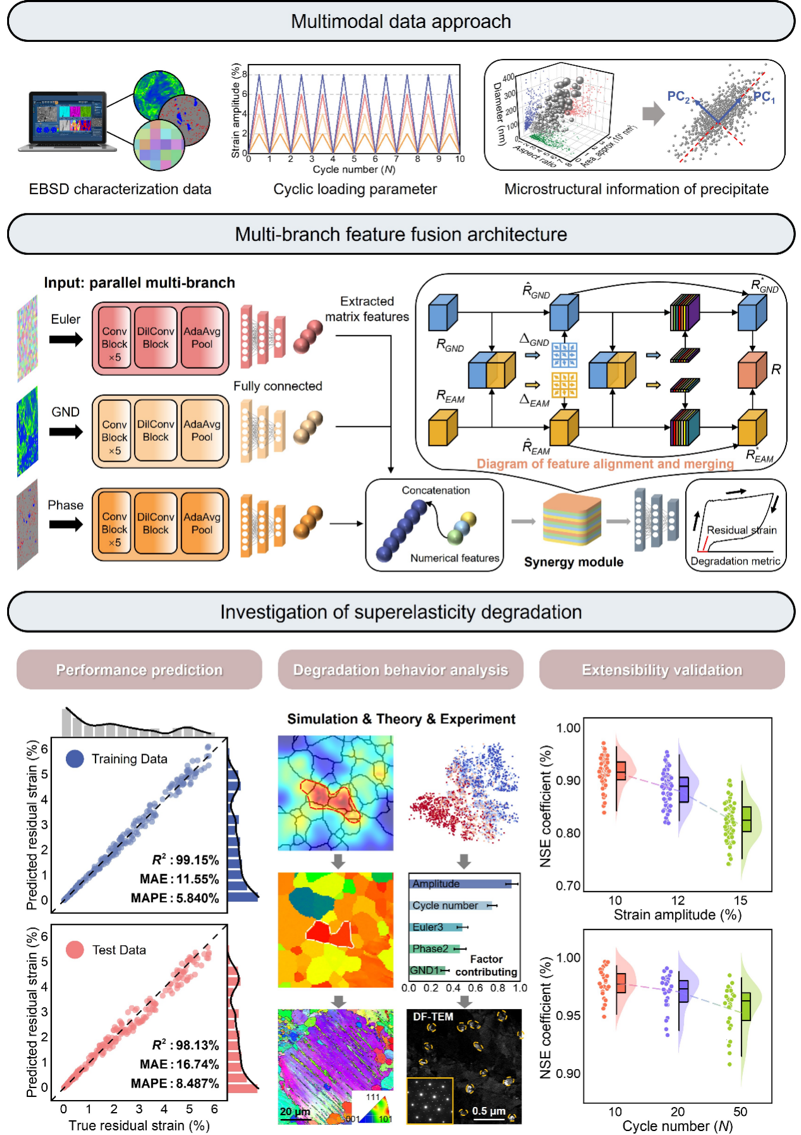
Multimodalinterpretablelearningframework for thesuperelasticdegradation of NiTialloys
HuYuejie, a doctoral student at Harbin Institute of Technology, Weihai, is the first author of the paper, and ProfessorWangChuanjieand ProfessorFuMingwang of The Hong Kong Polytechnic University are the co-corresponding authors. This research was supported by the Shandong Provincial Natural Science Foundation, the Fundamental Research Funds for the Central Universities (HIT Original Frontier Exploration Fund) and other projects. (Hu Yuejie)
Article link:https://doi.org/10.1038/s41467-026-77250-4
