


Zhang Qi, an early-career faculty member in Professor Wang Dafang’s team at the School of Automotive Engineering, Harbin Institute of Technology, Weihai, has recently made significant progress in lithium-ion battery diagnostics. The team has proposed a novel method for rapidly predicting lithium-ion battery impedance spectra from short-duration relaxation signals, providing a new technical pathway to identifying battery aging modes and enabling online health diagnostics. The findings, titled “Rapid Impedance Spectrum Extraction from Relaxation Signals via a Battery Kinetics-Informed Neural Network,” have been published in Energy Storage Materials, a top international journal in the energy field.
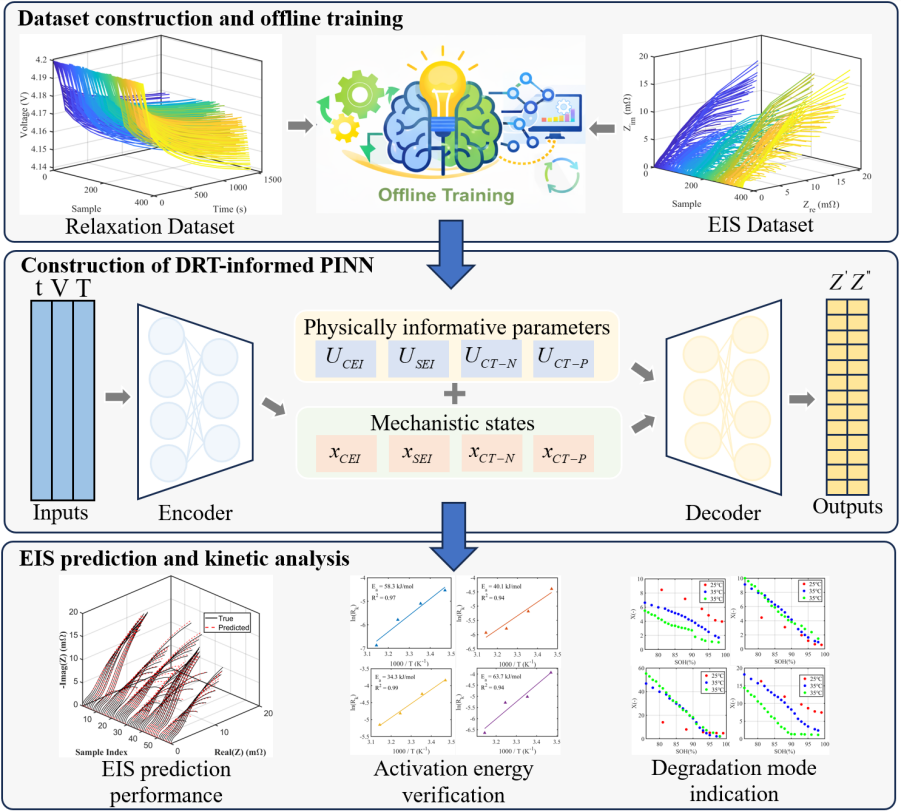
Flowchart for Rapid Impedance Spectrum Acquisition
In the fields of new energy vehicles and energy storage systems, rapid and accurate assessment of internal battery states is essential for improving the safety level of battery management systems. Electrochemical impedance spectroscopy (EIS), which reveals various kinetic processes within batteries, is an important tool for battery state estimation and fault diagnosis. However, conventional EIS measurements require frequency-by-frequency excitation and high-frequency sampling, resulting in long measurement times, high hardware requirements, and stringent testing conditions. These limitations hinder its direct application in embedded battery management systems.
To overcome this challenge, the research team proposed an innovative impedance spectrum prediction method that integrates a mechanism-guided distribution of relaxation times with a physics-informed neural network. Drawing on the characteristic timescales of different electrochemical processes in lithium-ion batteries, the method constructs a mechanism-guided distribution of relaxation times to represent complex impedance spectra using a small set of kinetic parameters with clear physical meaning. This representation is embedded in an encoder–decoder neural network, enabling the model to reconstruct complete impedance spectra directly from post-charge voltage relaxation signals. The model offers substantial advantages in prediction accuracy and physical interpretability, reconstructing impedance spectra from as few as 15 relaxation voltage data points. A physically constrained loss function helps suppress the nonphysical solutions and unstable extrapolation often associated with purely data-driven models. This work provides a new technical pathway for rapidly obtaining battery impedance spectra from short-duration relaxation signals, identifying aging modes, and enabling online health diagnostics.
Harbin Institute of Technology, Weihai, is the lead corresponding institution for the paper. Chen Shiqin, a doctoral student at the School of Automotive Engineering, is the first author, while Zhang Qi and Professor Wang Dafang are co-corresponding authors. The research was supported by the National Natural Science Foundation of China, the Shandong Provincial Natural Science Foundation for Young Scientists, and other funding programs.
(Chen Shiqin)
Paper link: https://doi.org/10.1016/j.ensm.2026.105339
