


Recently, Professor Ryan’s team from the School of Science at the Harbin Institute of Technology (Weihai) has made important progress in the multidimensional manipulation of complex structured light fields and their information applications. The related research results, entitled “Multi-focus Synthesis of Space-Variant Polarized Structured Light Beams for Multidimensional Optical Information Encryption” and “Tunable Subwavelength Optical Skyrmions Embedded in Bottle Beams via Metasurfaces,” respectively, have been published in the optics top-tier journalLaser & Photonics Reviews.
Structured light fields refer to complex light fields formed by artificially-designing degrees of freedom such as the amplitude, phase, polarization, and spatial distribution of light. Compared with traditional uniform light fields, structured light fields can carry and manipulate information using dimensions such as spatial modes, polarization states, and topological charges, and have important application value in fields such as optical communication, optical storage, holographic display, optical encryption, and quantum information.
However, the generation and application of complex structured light fields face two challenges. On the one hand, traditional vortex light fields and orbital angular momentum holographic systems mainly use topological phase or topological charge for manipulation and encoding, and have not yet fully exploited the synergistic effects of multidimensional degrees of freedom such as polarization, amplitude, and spatial morphology. On the other hand, subwavelength topological light fields usually rely on near-field effects or complex optical systems, making it difficult to simultaneously achieve far-field transmission, nanoscale localization, and device integration.
How to construct topological light fields on a smaller spatial scale and further realize multidimensional, dynamic, and programmable light field manipulation is a key issue for complex structured light research moving from fundamental physics to information applications. The team has carried out systematic research around degrees of freedom such as the spatial morphology, amplitude, phase, polarization, and topological properties of light fields, and has successively made breakthroughs in information encryption applications of space-variant polarization vortex light fields and the fine construction of subwavelength topological light fields. Through multi-focus synthesis and phase–amplitude–polarization joint modulation, flexible construction of space-variant polarization vortex structured light fields has been achieved, and an orbital angular momentum holographic encryption system with a dynamic polarization switching function has further been established. On this basis, the team further extended the concept of multi-degree-of-freedom collaborative manipulation to the nanoscale, using spin-multiplexed all-dielectric metasurfaces and optical super-oscillation mechanisms to realize tunable subwavelength optical skyrmions at the dark focus of a three-dimensional optical bottle.
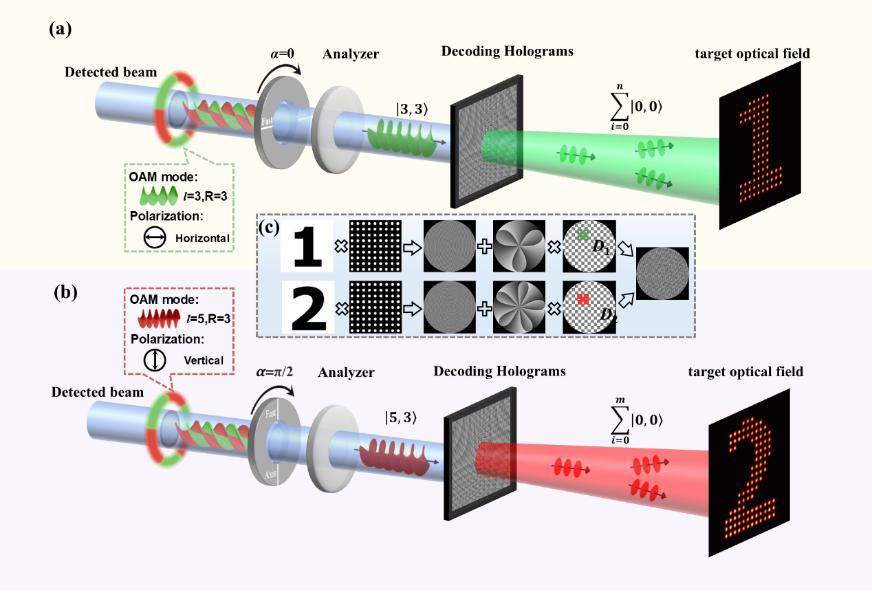
OAM holographic encryption system with polarization switching function
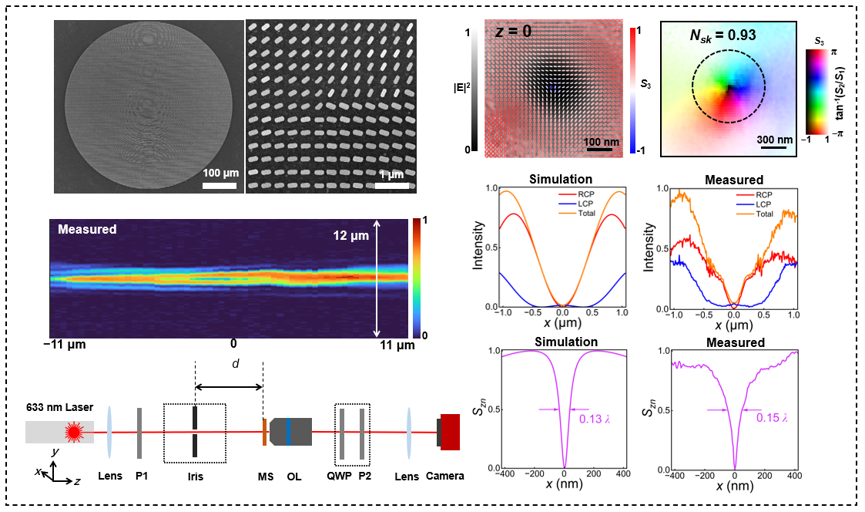
SEM image of the metasurface and the generated subwavelength optical skyrmion
The related research has established a complete research route from information encoding and applications of propagating structured light fields to the fine tuning of subwavelength topological light fields, and has important potential value in the multidimensional and multiscale dynamic manipulation of structured light fields and their applications in fields such as optical information processing and high-density on-chip quantum storage.
PhD students Rui Liu and Kaixiang Cheng from the School of Science at the Harbin Institute of Technology (Weihai) are the first authors, and Professor Yan Li is the corresponding author of these papers. This research was supported by the National Natural Science Foundation of China and the Key Research and Development Program of Shandong Province. (Rui Liu)
Article links: https://doi.org/10.1002/lpor.202501944
https://doi.org/10.1002/lpor.71635
