


Recently, a research team led by Prof. Caiwang Tan and Dr. Jianhui Su from the School of Materials Science and Engineering and the Shandong Provincial Key Laboratory of Special Welding Technology, Harbin Institute of Technology, Weihai, made important progress in understanding the electronic bonding mechanism at welded interfaces between carbon-fiber-reinforced thermoplastic composites (CFRTPs) and metals.From an electronic-structure perspective, the team proposed a new strategy for strengthening metal/CFRTP interfaces through the synergistic interaction between low-energy unoccupied orbitals of interfacial metal cations and functional groups on the polymer side. The study revealed an electron donor-acceptor-driven coordination bonding mechanism, offering new insight into the long-standing challenges of insufficient interfacial strength and unclear bonding origins in metal/CFRTP welding.
The work, entitled “Elucidation of the intrinsic electronic mechanism governing interfacial chemical bonding in metal-polymer hybrids,” was published in Nature Communications.
Metal-CFRTP hybrid structures combine the high strength and stiffness of metals with the low density, corrosion resistance, and design flexibility of thermoplastic composites, making them highly attractive for aerospace, transportation, electronic devices, and energy-related applications. Direct welding offers an efficient route to integrating metals and CFRTPs while avoiding the weight penalty of mechanical fasteners and the aging issues associated with adhesives. However, the pronounced differences in crystal structure and physicochemical properties between metals and thermoplastic composites make it difficult to establish stable chemical interactions across the welded interface, thereby limiting joint strength and long-term reliability. Most existing approaches rely primarily on surface roughening and mechanical interlocking, while a unified understanding of how chemical bonds form at welded interfaces and why different material combinations exhibit distinct joining performance has remained lacking.
To address these challenges, the team systematically investigated the interfacial interactions between metal oxides and polymer functional groups at the electronic scale. The results showed that interfacial metal sites can act as electron acceptors, while polymer functional groups serve as electron donors, enabling the formation of stable coordination bonds through charge transfer and orbital hybridization. This interfacial bonding mechanism was further validated experimentally using valence-band photoelectron spectroscopy.
Based on this mechanism, the researchers developed a synergistic interface-engineering strategy combining metal-surface oxidation, oxygen-vacancy construction, and carboxyl functionalization of the polymer surface to actively regulate the interfacial electronic structure and chemical bonding capability. The optimized metal-CFRTP welded joints achieved a tensile-shear strength of approximately 30 MPa, more than five times that of untreated joints and reaching a leading level among comparable studies. The failure mode also shifted from interfacial debonding to cohesive failure within the polymer, indicating that the welded interface was transformed from the weakest region of the joint into an effective load-bearing and load-transfer zone.
To further examine the general applicability of the proposed framework, the team extended the analysis to structural metals with different cation valence states and thermoplastic polymers containing oxygen-, nitrogen-, and sulfur-bearing functional groups. The results demonstrated that appropriate matching between the surface electronic characteristics of metals and the functional chemistry of polymers plays a critical role in determining interfacial bonding and joining performance. A systematic survey of previously reported metal-polymer joining data further showed that the interfacial bonding trends observed across different material combinations were broadly consistent with the proposed framework. This work moves metal–thermoplastic joining beyond empirical optimization based solely on processing parameters and surface morphology, providing a theoretical basis for material selection, interface regulation, and the design of high-performance welded joints.
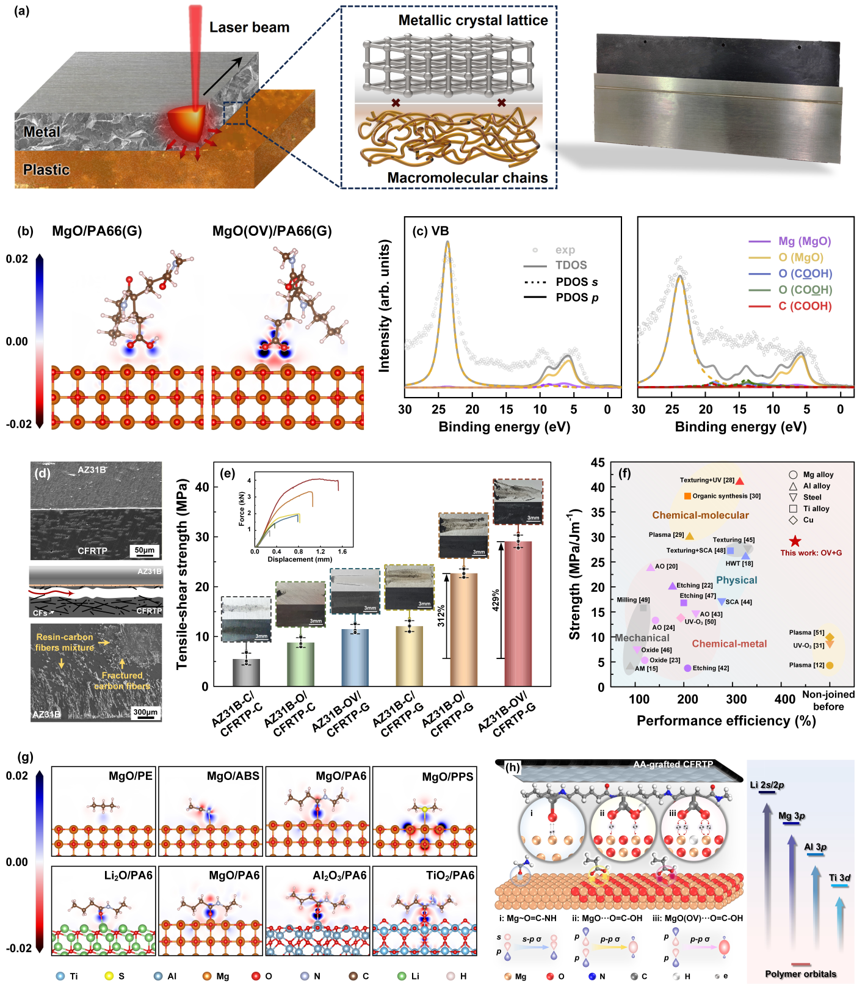
Induction of interfacial chemical bonding and bonding mechanism analysis in metal-CFRTP hybrid interfaces
Harbin Institute of Technology is the first corresponding institution of the paper. Yifan Liu, a doctoral student at the School of Materials Science and Engineering, is the first author. Dr. Jianhui Su contributed to the supervision of the research, Prof. Caiwang Tan is the corresponding author, and Prof. Xiaoguo Song provided overall guidance on the research direction and study development. The work was carried out in collaboration with Prof. Swee Leong Sing’s team at the National University of Singapore and was supported by the National Natural Science Foundation of China, the National Science and Technology Major Project, and the Natural Science Foundation of Shandong Province.
(Yifan Liu)
Article link:https://www.nature.com/articles/s41467-026-75952-3
