


Recently, the team led by Professor Zhong Bo from the School of Materials Science and Engineering at the Harbin Institute of Technology (Weihai) has achieved significant progress in research on radar-infrared synergistic stealth materials. The team introduced triatomic oxygen-boron-oxygen (OBO) termination onto the surface of two-dimensional transition metal carbide (TiC MXene) and, leveraging the dipole-plasmon synergistic effect, successfully achieved radar-infrared synergistic stealth. The related findings were published in the materials science top-tier journal Advanced Functional Materialsunder the title “Dipole-Plasmon Synergistic Ordered Triatomic-Terminated MXene with Multi-Spectrum Selectivity for Integrated Radar-Infrared Stealth.”
With the increasing threat of multi-spectrum detection, single-spectrum stealth technology can hardly satisfy the requirements of modern information defense combat. Radar stealth requires materials to efficiently absorb incident electromagnetic waves, while infrared stealth demands a low infrared emissivity on the material surface to suppress thermal radiation. These two requirements are fundamentally contradictory in physical mechanisms, making it difficult to achieve dual-function design within a single material system. Addressing this bottleneck has become a core research focus in stealth materials in the field of stealth materials.
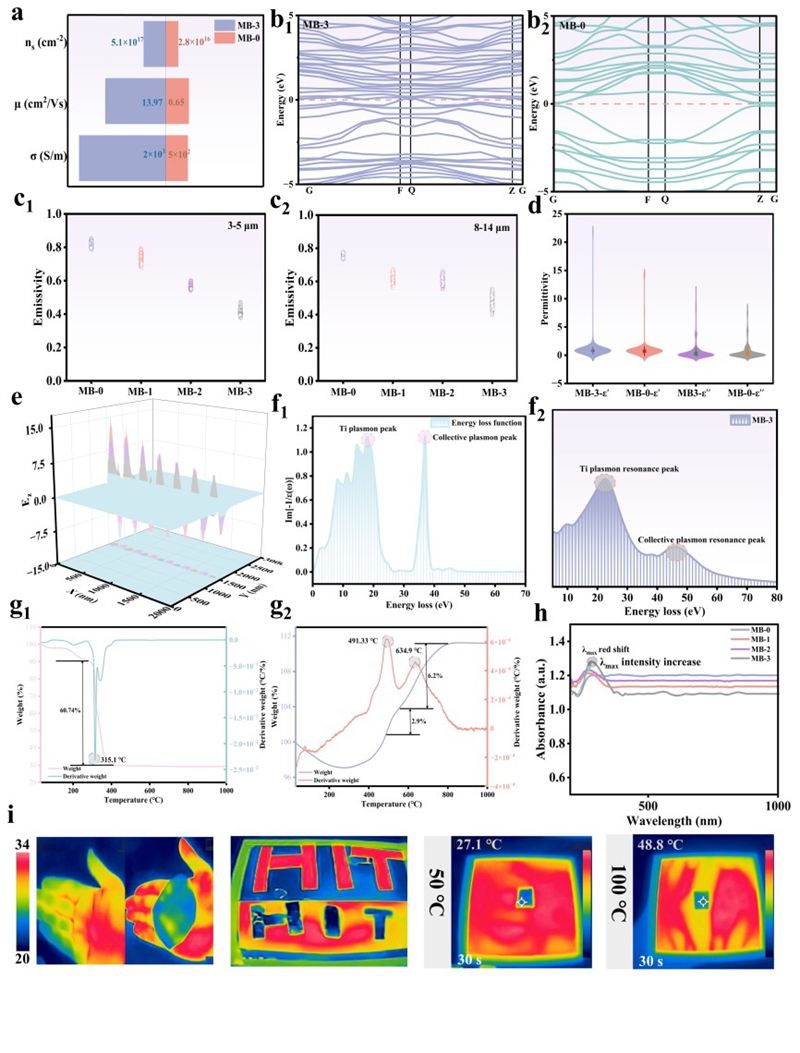
To address this problem, the team innovatively constructed an ordered triatomic OBO-terminated TiC MXene material. Their study shows that OBO termination increases the number of dipoles, enhances polarization capability, and tunes the relaxation time of TiC MXene, effectively promoting electromagnetic wave absorption and achieving excellent radar stealth performance. Meanwhile, the ordered triatomic OBO termination can hybridize with the 3d orbitals of Ti in TiC MXene, forming d-p-π conjugation (Ti-O-B-O), which significantly improves electron delocalization and results in a more uniform electron distribution, analogous to a metallic electron gas. This, in turn, reduces absorption and emission in the infrared band, giving the material a low infrared emissivity. By combining multiple characterization techniques with theoretical calculations, the study systematically reveals the synergisticregulation mechanism of the ordered triatomic termination structure on electromagnetic wave absorption and infrared emission. This achievement provides a new approach to resolving the contradiction between radar and infrared stealth mechanisms and lays a crucial theoretical foundation for developing multi-spectrum compatible stealth materials.
Harbin Institute of Technology (Weihai) is the primary completion unit of this paper. Yang Minghao, a master’s student in the School of Materials Science and Engineering, serves as the first author, while Zhong Bo and Liu Dongdong serve as co-corresponding authors. This research was supported by the National Natural Science Foundation of China, the Natural Science Foundation of Shandong Province, and other funding sources.
Paper link: http://doi.org/10.1002/adfm.76616
Schematic Illustration of Infrared Stealth Mechanism
