


Recently, a research team led by Professor Long Xia from the School of Materials Science and Engineering, Harbin Institute of Technology, Weihai, has made significant progress in electromagnetic wave absorbing materials for marine environments. The team’s latest research, titled “Electronic Delocalization of Fe Atom-Cluster for Long-Term Stable Electromagnetic Wave Absorption in Marine Environments,” has been published in the international journal Nano-Micro Letters.
With the rapid development of wireless communication and radar detection technologies, the marine electromagnetic environment has grown increasingly complex, placing greater demands on electromagnetic protection materials for marine equipment. For offshore equipment, electromagnetic wave absorbing materials must not only be lightweight and provide broadband, strong absorption, but also remain operationally stable under prolonged exposure to high humidity, salt spray, and corrosive ions. Compared with terrestrial environments, however, marine environments contain abundant chloride ions that continuously attack the active sites and conductive networks of absorbing materials, leading to deterioration in dielectric response, impedance matching, and long-term absorption performance. Achieving both efficient electromagnetic attenuation and corrosion-resistant stability in marine environments has therefore become a key challenge in the design of marine protective materials.
To address this challenge, the team proposed a delocalized electron regulation strategy based on the synergistic construction of Fe single atoms-clusters. By creating cooperative Fe single-atom and Fe-cluster sites on a π-conjugated carbon framework, the researchers formed a multicenter orbital-coupling network. This enables incident electromagnetic waves to undergo multiple loss processes within the material, including dipole relaxation, interfacial polarization, and electron transport, thereby dissipating electromagnetic energy efficiently.
The study found that the electronic delocalization effect between Fe clusters and Fe single atoms effectively extends charge-transport pathways and establishes continuous delocalized-electron channels, simultaneously enhancing conduction and polarization losses. In terms of stability in marine environments, the Fe clusters preferentially adsorb chloride ions and generate locally negatively charged regions. This mitigates the direct corrosion of Fe single-atom active sites by chloride ions and preserves the long-term stability of the material’s key electromagnetic-response units and conductive network. This synergistic mechanism moves beyond conventional design strategies that mainly rely on passive encapsulation or complex structural protection, enabling simultaneous enhancement of electromagnetic loss and corrosion resistance.
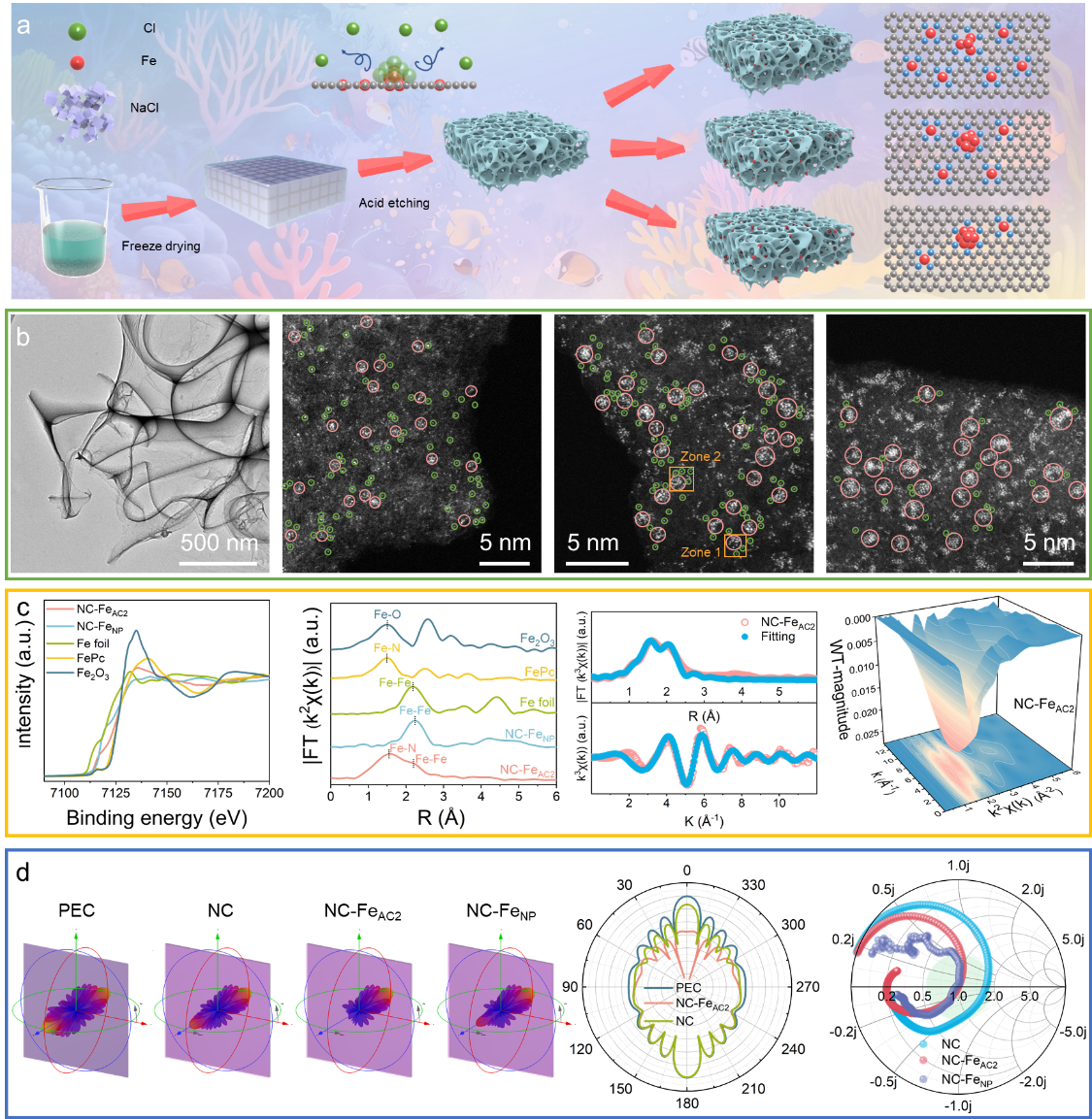
(a) Schematic illustration of the material preparation process; (b) Microstructure; (c) Coordination environment; (d) Electromagnetic wave absorption performance
Experimental results show that the material delivers excellent broadband and strong absorption even at a low filler loading, while maintaining good long-term stability in simulated marine environments with high salinity and humidity. The work offers a new strategy for the electromagnetic protection of marine equipment and the development of adaptive materials for complex electromagnetic environments. Going forward, the team will investigate the stability mechanisms, flexible applications, and scalable engineering fabrication of electromagnetic wave-absorbing materials in marine environments, to advance their practical application in materials engineering.
Harbin Institute of Technology is listed as the first corresponding affiliation of this work. Shaocong Zhong, a doctoral student in the School of Materials Science and Engineering at the Weihai Campus, is the first author. Young faculty members Dr. Pianpian Zhang and Dr. Yanan Yang, together with Professor Long Xia, are co-corresponding authors. The research was financially supported by the National Natural Science Foundation of China and other provincial and ministerial research funds. (Reported by Shaocong Zhong)
Paper link:https://doi.org/10.1007/s40820-026-02210-y
