


Recently, a research team led by Professor Song Xiaoguo from the State Key Laboratory of Advanced Welding and Joining at Harbin Institute of Technology (HIT) has made significant research progress in the high-temperature joining of ceramic matrix composites and refractory metals.
The related research findings, titled Semi-solid Brazing via CoCrFeNiCuₓ High-entropy Alloy Fillers: Interfacial Microstructure, Mechanical Properties, and Joining Mechanism of C/C-SiC Composites and TZM Alloy, have been published in Advanced Composites and Hybrid Materials.
In the aerospace sector, there is an increasingly urgent demand for lightweight, high-strength, and high-temperature-resistant components. C/C-SiC composites are highly favored for their excellent high-temperature performance, low coefficient of thermal expansion, and outstanding mechanical strength. However, achieving high-quality joints between these ceramic matrix composites and TZM (Titanium-Zirconium-Molybdenum) refractory alloys still faces severe challenges, including excessively high brazing temperatures, poor metallurgical compatibility, and the susceptibility to brittle phase precipitation.
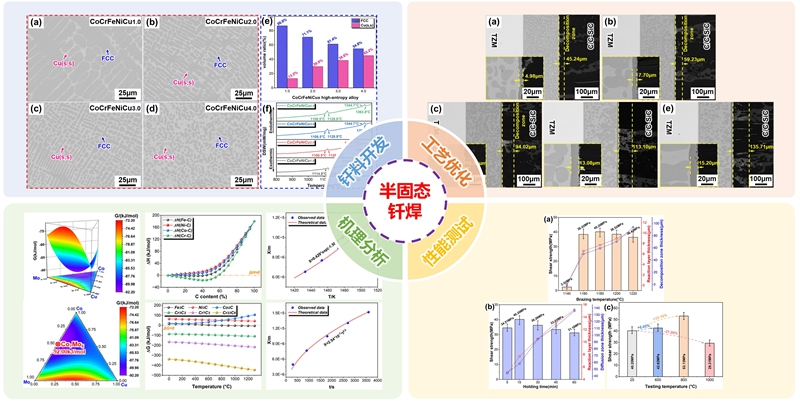
To break through this bottleneck, the research team proposed a “semi-solid brazing” strategy. The study developed a series of CoCrFeNiCux high-entropy alloy (HEA) fillers, leveraging their unique “double endothermic peak” melting behavior to establish a controllable semi-solid window. Within this window, the Cu-rich liquid phase in the filler metal not only ensures good fluidity and wettability but also effectively suppresses excessive chemical reactions at the interface.
The study revealed that the composite filler exhibits excellent microstructure evolution characteristics during the joining process: On the TZM alloy side, a continuous μ-Co7Mo6 layer is formed through chemical-potential-driven elemental substitution. On the composite side, an M7C3 reaction layer and a decomposition zone containing graphite, SiC, and Cu3Si are generated.
Experimental results demonstrate that the joints brazed at 1180 °C for 15 minutes achieved a room-temperature shear strength of 40.2 MPa. Notably, the joints exhibited an “anomalous strengthening” effect, where the strength increased rather than decreased at 800 °C. This is primarily attributed to the excellent high-temperature plasticity of the HEA filler, which accommodated and released the thermal residual stress of the joint.
Furthermore, combining finite element modeling (FEM), the team deeply elucidated the stress distribution and fracture mechanisms. The analysis confirmed that normal stress is the critical factor leading to joint failure and identified the effective release pathway of residual stress within the 600–800 °C temperature range. This study provides a new design methodology and theoretical foundation for the heterogeneous joining of ceramic matrix composites and refractory alloys.
Currently, the team is dedicated to further optimizing the filler compositions and exploring the long-term service stability of this technology under extreme high-temperature environments, aiming to promote the engineering application of advanced material joining technologies in aerospace hot-section components.
Harbin Institute of Technology is the primary corresponding institution for this paper. Zhou Wenlong, a PhD candidate from the School of Materials Science and Engineering at the Weihai Campus, is the first author of the paper. Hu Shengpeng, a Senior Engineer from the Large-scale Instruments & Equipment Testing and Management Center of the Weihai Campus, and Professor Fu Wei from the School of Materials Science and Engineering are the co-corresponding authors. Professor Hyoung-seop Kim from the Pohang University of Science and Technology (POSTECH) in South Korea also participated in the related research work.
This research was financially supported by the Joint Fund Key Project of the National Natural Science Foundation of China (NSFC), the Shandong Provincial Natural Science Foundation for Distinguished Young Scholars, and the HIT Youth Scientist Studio.
Paper Link: https://doi.org/10.1007/s42114-026-01807-6
