


Recently, the research team led by Professor Su Xin and Associate Professor Zhou Weiwei from the Advanced Lithium Battery Technology Research Center of the campus, in collaboration with Hubei Wanrun New Energy Technology Co., Ltd., has achieved significant progress in the field of lithium battery prelithiation. The team proposed a method of asphalt softening-induced coating to form a dense carbon layer on the surface of lithium-rich iron lithium oxide particles, which significantly improves the air stability of the material. Entitled "Air-stable Li5FeO4 Additive Enabled by Carbon Coating for Energy-dense Lithium-ion Batteries," the relevant findings were published in Nature Communications, a world-renowned international journal.
With the rapid development of the electric vehicle and energy storage industries, the demand for high energy density and long cycle life in lithium-ion batteries has become increasingly urgent. However, during the first charging process, lithium-ion batteries often suffer from active lithium loss, leading to reduced capacity and shortened service life, which has become a critical bottleneck restricting the application of high specific energy lithium-ion batteries. To address this issue, the research community has proposed a strategy of adding lithium supplement agents to compensate for lithium loss. Among these, cathode lithium supplement agents have attracted considerable attention due to their simple process, high safety, and good compatibility with existing production workflows. Nevertheless, no additive currently available can simultaneously possess both high capacity and excellent air stability, a deficiency that severely limits their practical applications.
To address this issue, the team combined the high-capacity characteristics of Li5FeO4with a carbon coating strategy, constructing a dense and uniform protective layer on the material surface using asphalt as the carbon source. This effectively blocks its reaction with active components in the air, significantly enhancing environmental stability. The carbon coating structure not only inhibits the performance degradation of the material during storage and processing but also improves lithium-ion diffusion rate and charge transfer efficiency by introducing interface defects and oxygen vacancies. Integrating multiple characterization techniques and theoretical calculations, the research systematically reveals the stability regulation mechanism and structural evolution process, and verifies its application potential in improving energy density and cycling stability at the battery device level. This achievement provides a new idea for the practical application of high-capacity lithium supplement agents and lays an important foundation for the design and development of high-energy-density lithium-ion battery materials. The products related to the paper have entered the verification process of several leading lithium battery enterprises, marking a key step toward engineering application.
Liu Canshang, a doctoral candidate at the campus, is the first author of the paper, while Professor Su Xin and Associate Professor Zhou Weiwei serve as the corresponding authors. Harbin Institute of Technology, Weihai is the sole corresponding unit of the paper. This research was supported by the Key Research and Development Program of Shandong Province, the National Natural Science Foundation of China, and the Natural Science Foundation of Shandong Province, among other projects.
Original link: https://doi.org/10.1038/s41467-025-62418-1
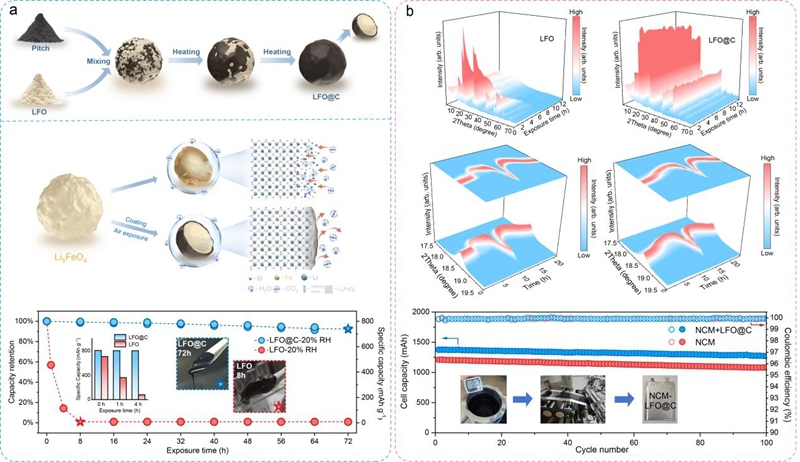
(a) Structural regulation mechanism and performance verification of carbon coating for enhancing the air stability of Li5FeO4; (b) Application performance verification of Li5FeO4@C
