


Recently, the research team led by Associate Professor Bian Hong from the School of Materials Science and Engineering of the campus has achieved significant results in the field of heterogeneous material joining for aero-engines. Entitled "Recent Advances on Joining of CMCs Heterogeneous Joints for Aeroengine Industry: Residual Stress Control, High-Temperature Fillers Development and SiC-Ni Reaction Suppression," the findings were published in Composites Part B: Engineering—a top-tier journal in the composites field. Based on the team's own research outcomes, the paper systematically elaborates on the research progress of brazing technology between ceramic matrix composites (CMCs) and metals. Focusing on the three core challenges of residual stress control, high-temperature filler development and interfacial reaction suppression, it provides critical theoretical support for the manufacturing of hot-end components of aero-engines.
Ceramic matrix composites (CMCs), with their low density, outstanding high-temperature resistance and stability, are regarded as ideal materials to replace traditional superalloys for the hot-end components of next-generation aero-engines. In practical applications, CMCs often need to achieve reliable joining with metals. Among the commonly used methods such as adhesion, mechanical joining and brazing, brazing technology is considered the most promising joining solution due to its advantages including minimal post-welding deformation, high joining precision and suitability for batch production. However, the brazing of CMCs and metals still faces a series of severe challenges, mainly including residual stress caused by mismatched thermal expansion coefficients, insufficient high-temperature strength of traditional brazing fillers and excessive interfacial reactions.
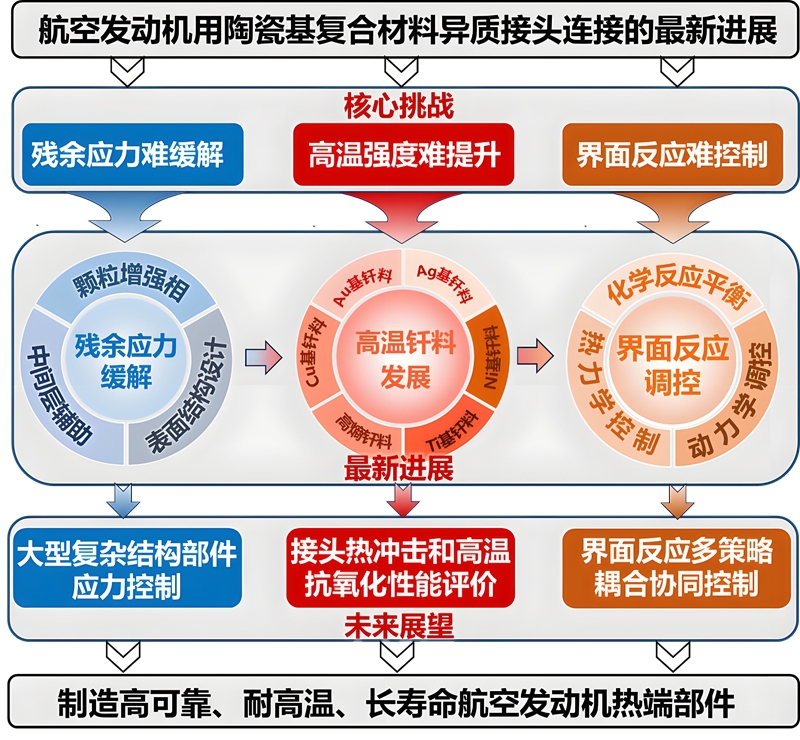
Integrating the team's own research work, the paper systematically summarizes for the first time the strategies and their effectiveness for addressing these challenges from three key aspects. In terms of residual stress mitigation, it focuses on analyzing the alleviation effects of three approaches: particle-reinforced brazing fillers, interlayer-assisted control and surface structure design, and points out that interlayer design can fundamentally reconstruct stress distribution, which serves as a critical pathway to enhance joint performance. Regarding the development of high-temperature brazing fillers, it comprehensively sorts out the applicable temperature ranges and development trends of various filler systems including Ag-based, Au-based, Cu-based, Ti-based and Ni-based ones, providing a basis for material selection under different service conditions. As for the control of excessive SiC-Ni reactions, it thoroughly elaborates on three interfacial reaction regulation mechanisms based on chemical reaction equilibrium, thermodynamic control and kinetic adjustment, and emphasizes the key role of diffusion barrier layers in heterogeneous joining.
The paper further points out that future efforts should be devoted to developing full-scale stress coordinated control methods for large-scale complex components, strengthening research on the performance evolution and life assessment of heterogeneous joints under extreme working conditions such as thermal shock and high-temperature oxidation, and advancing the coordinated regulation of multiple mechanisms including chemical equilibrium, thermodynamics and kinetics, so as to establish an integrated technical system covering stress design, material development and interface control, thereby providing systematic solutions for the manufacturing of high-reliability and long-life hot-end components of aero-engines.
Chen Xiukai, a doctoral candidate from the School of Materials Science and Engineering of the campus, is the first author of the paper, while Associate Professor Bian Hong and Professor Song Xiaoguo serve as the corresponding authors. This research work was completed with the assistance and guidance of the China Aero-Polytechnology Establishment.
Link to the Paper:https://doi.org/10.1016/j.compositesb.2025.113181
