


From August 27 to 29, the "Artificial Intelligence Empowering Modern Industrial Development" Expert Innovation Forum, hosted by the Ministry of Human Resources and Social Security and the Shandong Provincial People's Government, and organized by the Shandong Provincial Department of Human Resources and Social Security, the Weihai Municipal People's Government, and Harbin Institute of Technology (Weihai), was held in Weihai.
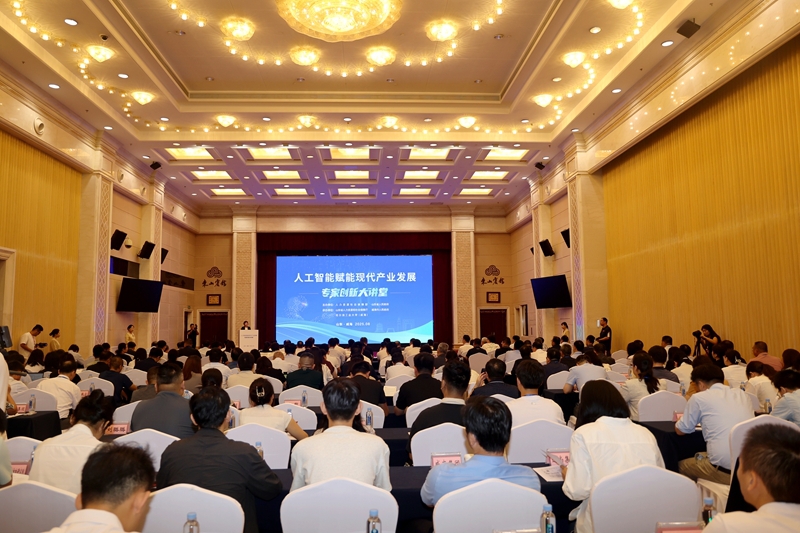
Li Jinsheng, Director of the Department of Professional and Technical Personnel Management of the Ministry of Human Resources and Social Security; Zhang Tao, Secretary of the Party Committee and Director of the Shandong Provincial Department of Human Resources and Social Security; Kong Fanping, Deputy Secretary of the Weihai Municipal Party Committee and Mayor of Weihai; and Tan Yiqiu, Assistant to the President of Harbin Institute of Technology and President of Harbin Institute of Technology (Weihai), attended the launching ceremony and delivered speeches. Gao Qing, Second-Level Inspector of the Department of Professional and Technical Personnel Management of the Ministry of Human Resources and Social Security; Zhou Chunyan, Deputy Director and First-Level Inspector of the Shandong Provincial Department of Human Resources and Social Security; Liu Kuizhong, Vice Mayor of Weihai; and Zhang Wencong, Vice President of Harbin Institute of Technology (Weihai), also attended the launching ceremony. More than 300 people participated, including experts and scholars in the field of artificial intelligence from across the country, entrepreneurs, postdoctoral young talents, representatives of digital technology engineer training institutions, and relevant officials from provincial and municipal human resources and social security departments.
The expert innovation forum, focusing on the needs of local industrial development, is a pilot reform initiative for the management and service of professional and technical personnel launched by the Ministry of Human Resources and Social Security this year. The forum, centered on the theme of artificial intelligence empowering modern industrial development, conducts cutting-edge academic and technical discussions and industry matchmaking services. Its aim is to inspire strategic and forward-looking thinking among experts in the field of artificial intelligence, foster more original and groundbreaking achievements, accelerate the deep integration of the digital economy and the real economy, and provide talent support for high-quality local development.
In the keynote speech session, Academician He You of the Chinese Academy of Engineering introduced the latest research progress and application directions of artificial intelligence (AI) technology from three perspectives: theoretical frontiers, technological frontiers, and industrial frontiers. Professor Xu Xiaofei, former Vice President of Harbin Institute of Technology and former President of Harbin Institute of Technology (Weihai), provided an in-depth analysis of the integration path of AI technology and urban development, emphasizing how AI can empower talent development and promote urban economic growth. The speeches analyzed the development trajectory and application prospects of AI from a global perspective, providing theoretical guidance for industrial upgrading.
The lecture series featured three sub-forums: Frontiers in Artificial Intelligence Technology, Digital Talent Cultivation, and AI-Powered Enterprise Digital Transformation. Several high-level experts and business leaders were invited to deliver keynote speeches, promoting precise alignment between "academia, industry, and talent," and jointly exploring new scenarios for industry-education integration. Simultaneously, an expert tour on "Digital Technology Empowering High-Quality Enterprise Development" was held, with 25 participating experts and young PhDs (post-doctoral fellows) conducting in-depth visits and exchanges with enterprises to understand the construction of innovative industrial ecosystems and the cultivation of digital talent, and to precisely address technological bottlenecks and development needs.
