


Recently, Professor Wang Fuqiang’s team from the School of New Energy on campus has made significant research progress in the interdisciplinary field of high-value utilization of solid waste and thermal management materials. The relevant results, entitled "Bio-Inspired Janus Composite with Dual-Phase Change Ranges for All-Season Thermal Comfort," were published in Advanced Composites and Hybrid Materials, a journal under Springer Nature.
Passive thermal management materials are receiving increasing attention due to their sustainability. However, traditional designs are often limited to a single temperature environment, only meeting the thermal needs of a specific season or period, and are difficult to adapt to diverse temperature scenarios such as winter-summer transitions and day-night variations.
To address this core challenge, the research team innovatively constructed a biomimetic composite phase change material system integrating "photothermal absorption, radiative cooling, and a dual-phase change process." This material focuses on the natural nutrient transport structure of discarded pine wood, inheriting it through in-situ transformation to prepare a porous silicon carbide framework with high porosity (>70%), high thermal conductivity (29.8 W/(m・K)), and strong photothermal absorption capacity, enabling efficient capture and storage of sunlight and heat during cold days. Simultaneously, combined with the team's previous large-scale radiative cooling coating, it achieves efficient cooling in hot weather thanks to its high solar spectral reflectivity and atmospheric window emissivity. Furthermore, the team is the first to introduce a dual-phase change range phase change material into the field of passive thermal regulation, enabling temperature maintenance during comfortable nights and efficient thermal compensation during cold nights. The synergistic effect of these three elements achieves improved thermal comfort throughout the year. Outdoor testing and building simulations confirm that this material, when applied to building roofs, effectively improves building thermal comfort in different regions throughout the year.
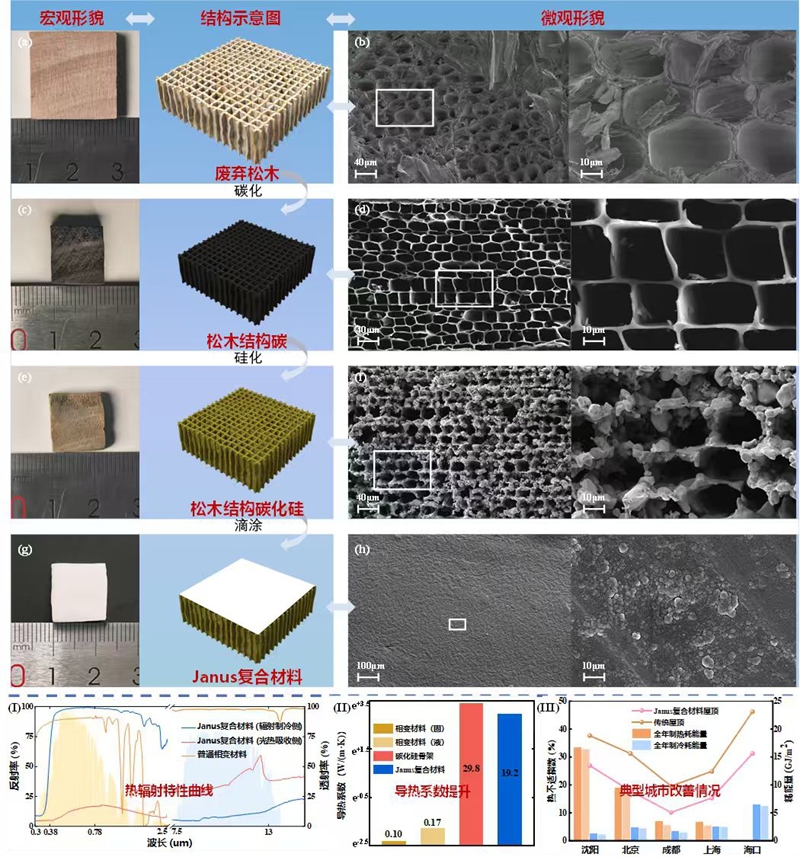
"Structural Evolution and Material Properties During the Preparation of Composite Phase Change Materials"
Currently, the team is continuously expanding the boundaries of solid waste raw materials, focusing on tackling the conversion technology of thermal storage materials for typical industrial solid wastes such as fly ash and coal gangue, and promoting this high-value conversion technology of solid waste from the laboratory to large-scale industrial application.
The corresponding author of this paper is Professor Wang Fuqiang, and the first author is doctoral student Chen Xudong. This research was supported by the National Natural Science Foundation of China and the Inner Mongolia Autonomous Region Science and Technology Program.
Link to the Paper:https://doi.org/10.1007/s42114-025-01558-w
