


Recently, China's first Gene Database System for Asphalt-Based Materials in Transportation Infrastructure (Version 1.0), jointly developed by a team led by Professor Tan Yiqiu and Professor Xu Huining from the School of Transportation Science and Engineering, HIT Weihai Campus, along with multiple universities including Southeast University, University of Science and Technology Beijing, Central South University, Wuhan University of Technology, Southwest Jiaotong University, Changsha University of Science & Technology, Shenzhen University, and enterprises such as CCCC Infrastructure Maintenance Group Co., Ltd. and China Merchants Chongqing Communications Technology Research & Design Institute Co., Ltd., was officially released at the 8th China-Europe Functional Pavement Workshop. The launch of this database will provide important references for the analysis of constitutive relationships, prediction of material performance, and intelligent design of materials in the field of asphalt-based materials in China, thus promoting the high-quality development of transportation infrastructure construction in China.
The research team has made continuous efforts to address the needs of intelligent reverse engineering and high-performance applications of asphalt-based materials for transportation infrastructure. They have broken through traditional design bottlenecks, empowered intelligent material research and development, and launched a gene database system for asphalt-based materials in transportation infrastructure(website: http://www.hit-asphalt-gene.cn).
Professor Tan Yiqiu stated that the traditional trial-and-error approach to asphalt-based material design is no longer sufficient to meet the needs of technological progress and social development. Materials genomics, supported by materials genome databases, based on the theoretical framework of reverse genetics, and guided by material functional requirements, offers a new and efficient approach to the reverse design and performance research of asphalt-based materials.
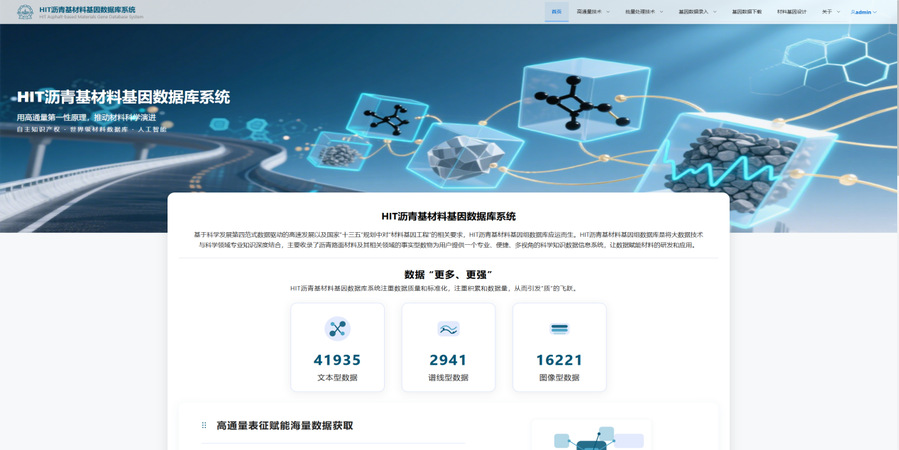
Gene database system for asphalt-based materials in transportation infrastructure
The Gene Database for Asphalt-Based Materials in Transportation Infrastructure serves as a multi-scale, multi-dimensional data integration system for asphalt-based materials. It utilizes high-throughput characterization techniques for rapid analysis of material properties, collecting and integrating experimental and simulation data at multiple scales to achieve diversified and comprehensive performance characterization. Employing multi-scale gene extraction technology, it establishes the correlation between typical road performance and gene units. Based on genome construction technology, it builds a "holographic genome" covering the relationship between material composition, structure, and performance. Through batch processing technology for asphalt-based materials genes, it processes massive amounts of gene parameters, mining, extracting, and analyzing characteristic parameters within the genomic feature space. Combined with gene standardization coding principles, it forms a large-scale holographic genome database for asphalt-based materials in transportation infrastructure. This genome database system, driven by the interplay of these six core technologies, breaks away from the traditional "black box" model of asphalt-based material design based on experience-trial-and-error methods, enabling intelligent design and high-performance applications of asphalt-based materials.
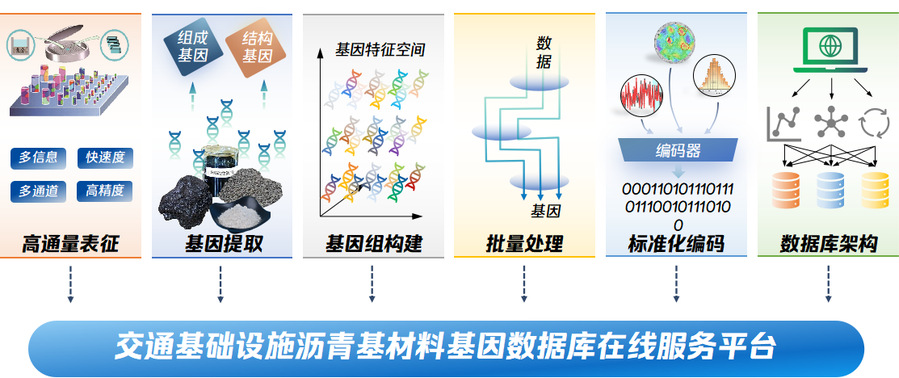
Six core technologies for asphalt-based materials in transportation infrastructure
Currently, the large-scale holographic gene database has included 40,000 sets of parametric data, 2,000 sets of spectral data, and 16,000 sets of image data. In practical engineering applications, it is expected to shorten the design cycle of the mix proportion by 72%, reduce the total cost by 56%, and improve road performance by 10% to 15%, thus demonstrating significant economic and social benefits.
The release of the Gene Database System for Asphalt-Based Materials in Transportation Infrastructure is a significant innovative practice in response to the "Outline for Building China’s Strength in Transportation," leading and promoting data-driven intelligent transformation of transportation. This system effectively addresses bottlenecks in traditional asphalt-based material design, such as difficulties in optimal design, low characterization efficiency, and poor prediction accuracy, significantly improving search efficiency, shortening the R&D cycle, and reducing trial-and-error costs. With continuous system improvement and functional expansion, it will further promote the transformation of asphalt-based material R&D from "experience-driven" to "data-driven," laying a solid foundation for the in-depth development of materials genome engineering for transportation infrastructure in my country.
